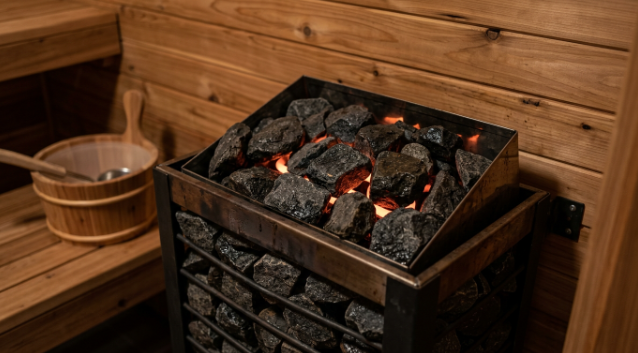
The strongest evidence on sauna bathing comes from Finnish cohort studies tracking thousands of people over years, and it shows an association between frequent sauna sessions and lower rates of fatal cardiovascular events, not proof that any specific heater or heating method causes that outcome. The research measures how often someone sits in a hot sauna, not what brand of heater produced the heat. Below is what six major findings actually say, and just as importantly, what they do not say.
1. Frequent Sauna Bathing and All-Cause Mortality
A large prospective cohort study published in JAMA Internal Medicine followed middle-aged Finnish men for roughly two decades and found that those who used a sauna four to seven times a week had a lower rate of fatal cardiovascular events and all-cause mortality compared with those who used one once a week. This is an association drawn from population-level data, not a controlled trial proving causation, and it says nothing about heater wattage or type since every subject used whatever sauna was locally available to them.
2. Fitness and Sauna Use Together
A follow-up study in Annals of Medicine looked at sauna bathing alongside cardiorespiratory fitness and found the two factors showed a joint association with lower cardiovascular and all-cause mortality risk. People with both higher fitness and more frequent sauna use showed the strongest association, suggesting sauna bathing and general physical condition may work together rather than sauna use alone driving the entire effect seen in earlier single-factor studies.
3. What Happens in the Body During a Single Session
A study in Heart and Vessels looked at short-term changes in blood-based cardiovascular markers among experienced sauna users immediately following a session, providing a physiological window into what a single sauna visit does to the body rather than tracking long-term outcomes. This kind of short-term data helps explain a plausible mechanism behind the longer cohort associations, though it does not by itself prove the long-term mortality findings.
4. The Heater Type Is Not What the Studies Measured
None of the underlying research distinguishes wood-burning heaters from electric heaters, or compares heater wattage, brand, or stone type. The studies measure sauna session frequency, duration, and temperature range broadly, drawing on Finnish public and home sauna use where a mix of heating methods has always been common. This matters for anyone reading heater marketing that implies a specific model produces unique health outcomes: the research supports regular, sustained heat exposure as the associated factor, not any particular way of producing that heat. A household deciding between an electric unit and a wood-burning one for a small cabin can make that choice based on budget, climate, and convenience without worrying that one option carries a research-backed edge over the other, because none of the cited studies were designed to detect a difference of that kind in the first place.
5. Association, Not Causation, and Real Contraindications
These are observational cohort studies, which means they can show a statistical association between behavior and outcome but cannot prove that sauna bathing directly causes the reduced mortality risk observed. People who use saunas frequently may differ from those who do not in other ways the studies cannot fully account for. It is also worth noting plainly that sauna heat is not appropriate for everyone: people with unstable angina, a recent heart attack, or certain arrhythmias are generally advised to be cautious, and pregnant women are typically advised to limit high-heat exposure.
6. Blood Pressure and Frequency Findings
A separate cohort analysis published in The Journal of Nutrition, Health and Aging looked specifically at how systolic blood pressure interacted with sauna bathing frequency and cardiovascular mortality risk in middle-aged and older Finnish men. The study found that the relationship between sauna frequency and mortality risk held even after accounting for baseline blood pressure, suggesting the association is not simply explained away by sauna users happening to have healthier blood pressure to begin with. This adds another layer of consistency to the broader pattern, though it remains observational data drawn from a specific population rather than a randomized trial.
7. What About Brain Health Claims?
Some marketing extends sauna benefit claims into cognitive territory, and there is a real research basis worth naming carefully. Cohort studies out of Finland have reported an inverse association between sauna bathing frequency and dementia risk in men, tracked over roughly two decades of follow-up. As with the cardiovascular findings, this is association data from an observational cohort, not a controlled trial, and it should not be read as proof that sauna use prevents cognitive decline in any individual. It does, however, fit the same broader pattern: consistent, long-term sauna bathing correlates with a range of favorable health markers across multiple studies from the same research group and others building on it.
8. The Practical Takeaway for Choosing a Heater
If the research associates benefit with regular, sustained sauna use rather than any specific equipment, the practical implication for a buyer is straightforward: pick a heater sized and installed correctly enough that the sauna actually gets used on a consistent schedule, since an oversized, undersized, or unreliable heater tends to sit unused. Buyers comparing heater options sized for consistent, easy weekly use can look at current models at SweatDecks, where kilowatt ratings and clearance specs are listed clearly enough to match a heater to a cabin that will actually get used regularly rather than becoming a rarely touched fixture.
Frequently Asked Questions
Does sauna heater brand or wattage affect the health research? No, the cohort studies track how often and how long people sauna bathe, not the specific equipment used to produce the heat.
How often do studies find sauna use needs to be to show an association? The strongest associations appeared at four to seven sessions per week in Finnish cohort research, with smaller associations at lower frequencies.
Is sauna bathing proven to prevent cardiovascular disease? No, the research shows an association with lower rates of fatal cardiovascular events, not proof of prevention for any individual.
Are there people who should be cautious about sauna heat? Yes, people with unstable angina, a recent heart attack, or certain cardiovascular conditions, and pregnant women, are generally advised to be cautious.
References
- Association between sauna bathing and fatal cardiovascular and all-cause mortality events, JAMA Internal Medicine, 2015
- Joint associations of sauna bathing and cardiorespiratory fitness on cardiovascular and all-cause mortality risk: a long-term prospective cohort study, Annals of Medicine, 2018
- Short-term effects of Finnish sauna bathing on blood-based markers of cardiovascular function in non-naive sauna users, Heart and Vessels, 2018
- The Interplay between Systolic Blood Pressure, Sauna Bathing, and Cardiovascular Mortality in Middle-Aged and Older Finnish Men: A Cohort Study, The Journal of Nutrition, Health & Aging, 2023
- Sauna bathing is inversely associated with dementia and Alzheimer’s disease in middle-aged Finnish men, Age and Ageing, 2017
By Paige Sorenson